
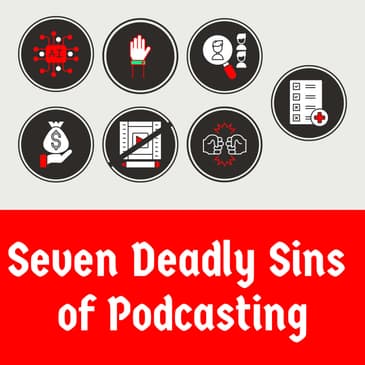
As I was watching the movie Se7en, I had a very strange thought: are your bad podcasting habits leading you down a path of (podcast) destruction? The movie is about the Seven Deadly Sins of the soul...but it got me thinking about how they might apply to podcasting. What “podcasting sins” are so great that they’ll lead to podfade (the unceremonious death of a podcast).
How do the Seven Deadly Sins (Lust, Gluttony, Greed, Sloth, Wrath, Envy, and Pride) translate to the world of podcasting. Let's take a look.
Want to read the entire article, and join the free mailing list? Head over to https://podcastworkflows.com/sins
- (00:00) - Intro
- (02:25) - Lust: Chasing Fads
- (08:37) - Gluttony: A Show for Everyone
- (12:45) - Greed: Revenue Above Audience
- (17:12) - Sloth: Not Editing Your Podcast
- (24:26) - Wrath: Controversy for Clicks
- (29:11) - Envy: Chasing Downloads
- (33:45) - Pride: Doing Everything Yourself
- (39:08) - You got this!
About Streamlined Podcaster: This is the show for solo podcasters who love their podcast but hate how much time it takes. Each week, host Joe Casabona shares the systems, workflows, and podcast automation that let you run a great show without burning out.
Joe has been a solo podcaster for 15+ years and helps solopreneurs replace manual tasks with reliable systems so they can take time off worry-free. He knows firsthand what it takes to produce a quality show solo — and he's here to help you do the same.
Get Joe's favorite podcasting tools: https://streamlinedpodcaster.com/tools
Connect with Joe on LinkedIn: https://www.linkedin.com/in/jcasabona/
[00:00:00] Around the time my wife and I started dating, I had a party in a few friends came over. One of them brought a contribution gift and it was wrapped in a box. And so in my best Brad Pitt impression, I said, And then my friend responded in kind.
[00:00:23] What's in the box? Erin's a few years younger than me and she had never seen the movie 7. So she didn't get that reference, but 7 is one of my favorite movies. It's from one of my favorite directors, David Fincher.
[00:00:42] The movie is about a serial killer who uses the seven deadly sins or really people who violate those seven deadly sins for his murders. It's a really gripping movie with great storytelling and an incredible then-end future all-starcast.
[00:01:04] And if you don't know, the seven deadly sins are lust glutany, greed, sloth, wrath, and v. And pride. They're considered in Christianity to be so grave because they lead to a life of immorality and the eventual death of the soul.
[00:01:23] And given that the seven deadly sins are hundreds of years old, you can imagine it's not the only place in pop culture where you'll find them. The movie Shazam and the TV shows the good place in
[00:01:36] Gilligan's Island as well as countless others have all portrayed either implicitly or explicitly the seven deadly sins. And that got me thinking about how they might apply to podcasting. What podcasting sins are so grave that they'll lead to podfade, the unceremonious death of a podcast.
[00:02:07] So in today's episode, we are going to look at the seven deadly sins of podcasting what they are and how to prevent them. Hey, everybody, my name is Joe Casabona and over here on podcast
[00:02:22] workflows you are going to learn how to save time and grow, automate and monetize your podcast. Let's dive into the first deadly sin which is lust. Lust is an intense desire for something sex, money, fame, power and in the case of podcasting lust is chasing the latest
[00:02:53] fad in hopes that it will be the thing that finally makes your show a hit. Something new like AI comes out and you have an intense desire to use it to your advantage. An AI is the current fad
[00:03:12] and people are using it or podcasters are trying to use it to replace them or at least heavily supplement them and their work. This can be by writing a script or creating questions for our
[00:03:26] guests instead of us coming up with the questions or using AI tools to do editing replacements where we'd be better off re-recording. I don't know if you've tried the eye contact feature in Descript but just re-shoot, it looks so weird and unnatural and that causes a disconnect
[00:03:51] between you and your listeners or your viewers. But AI isn't the only fad to potentially hurt podcasters a fad before AI was trying to convert clubhouse sessions into podcast episodes. But we quickly learned that a clubhouse conversation doesn't make a good podcast you are cheating by just taking
[00:04:21] a conversation that's recorded and trying to make it an episode. A conversation that's recorded does not a podcast make. And we also learned that clubhouse didn't make a particularly good app either, right? It just basically became a feature of Twitter with Twitter spaces. But
[00:04:42] Lust and Podcasting can also take the form of abusing genuinely good trends, right? It's not bad to try to make more money especially if you're trying to support your family. It's not bad to
[00:04:57] try to elevate yourself into a position of power to try to do good for your community. But abusing those things, that's where Lust comes in and trying to get too much of that thing.
[00:05:12] That's where Lust comes in. And so an example in podcasting is podcast swaps and gesting. Podcast swaps and gesting are genuinely helpful tools for podcast growth. But when you Lust after doing swaps or interviews, and you put yourself over the medium,
[00:05:36] it creates a bad experience for everyone involved. You start pitching every show regardless of if you'd actually be a good guest and provide value for the listeners and for the host. Your pitch has become so generic if not straight up bad because you're unfamiliar with the
[00:05:55] shows you're pitching. And then you can't from come from a place where you are genuinely trying to help the listeners. And when these tactics don't pay off, well, then you might decide that the
[00:06:13] effort you're putting in isn't worth it and you abandon podcasting even though the effort that you're putting in is not placed correctly. That's the problem with Lust. And so here's how you
[00:06:31] can avoid Lust. I would say that of the seven deadly sins of podcasting, this is the one that you can most easily fix. I tell my kids everything in moderation and so it should be the same with
[00:06:46] current fads. I'm not anti-AI, for example. I use it nearly every day, but I don't use it to remove myself from the creation process. I use it to supplement my work. Honestly, I use it mostly
[00:07:03] for ideas because anytime I've ever tried using AI to write something, even after it's been trained, even after I've given it really specific instructions like never use the word delve.
[00:07:18] It still doesn't come out very good. There are a few good points and I'll take them and reward them myself. When I do podcast swaps, I consider the angle and the audience. I don't consider going on other people's podcasts a content engine that I could put on autopilot.
[00:07:40] I'm trying to genuinely help people and forge good relationships with them so that they know I'm helpful. And yes, hopefully that leads to more work, more client relationships, more partnerships, more money. I'm self-employed and I have three kids. I need to make money.
[00:08:03] But not at the expense of the relationship. When you're considering ways to use the latest technologies, techniques or fads, ease into them, remember that there's no silver bullet. There's not a tool that's going to help you do everything for you without any intervention
[00:08:27] from you. That takes work and creating a great show for your audience. And speaking of, let's get into the second deadly sin, which is glutany. glutany is over consumption or over indulgence. And it's not just about eating too much. In fact, when I asked my AI tool
[00:08:55] perplexity, I told you I'm not anti-AI to summarize the seven deadly sins for me. It says this. glutany is not just about eating too much but also the obsession with consumption and the neglect of
[00:09:10] those in need. So how does this apply to podcasting? Well, tell me if you've heard or said this before. My show is for everyone. You want your show to reach as many people as possible, which means you need
[00:09:28] to talk to everyone, right? Wrong. When you are obsessed with overindulgence of listeners by trying to talk to everyone, you neglect a core niche audience that is in need of your expertise. And it's probably the most common deadly sin of podcasting because it's natural to want to reach
[00:09:53] a big audience. I have experienced with this one firsthand. When my podcast formerly named how I built it, launched in 2016, I was talking to a very specific group of people. WordPress developers who wanted to be business owners. But in 2018, my growth started to stagnate a little bit.
[00:10:22] So I decided to expand and talk to all developers and then all business owners. And you know what? My downloads plummeted. In my quest to consume more downloads, I neglected my core audience
[00:10:41] and I paid the price. Once I focused in on my niche again, my downloads came back up. So how do you avoid podcast gluttony? The best thing that you could do is define your audience.
[00:10:58] And I think the best way to do that is to create a mission statement for your podcast. The answers these three questions. Who are you talking to and be specific? What problem do they have? And how do you help them solve that problem?
[00:11:18] Terms like business owners and grow their business are too generic. There are so many business owners and most want to grow their business. But busy solopreneur parents is a great niche audience.
[00:11:32] And give them time saving processes or nomadic web developers and work wherever they travel are both great. Because that's a very specific problem that they have busy solopreneur parents. Feel like they don't have enough time to properly run their business and be a good parent.
[00:11:51] Nomadic web developers have a problem of Wi-Fi. And so you help them solve those problems. Get specific and you will see growth because those who need your podcast will know yours is the right one to listen to
[00:12:07] And they'll know that they can recommend it to their friends who are in similar situations. Now I understand the irony in this but before we get to greed,
[00:12:19] I do want to tell you that this article went out to my newsletter first. So if you want to save 12 hours per week on your podcast, you can join my free newsletter over at podcast workflows dot com slash join.
[00:12:36] There will also be a link in the description for this episode no matter where you're listening. Okay, so let's get to the third deadly sin which is greed. Greed is putting revenue above your audience. And I'm not going to tell you that making money from your podcast
[00:12:57] at all is greedy. You should make money with your podcast. I definitely try to make money. I do make money and don't try. I make money with my podcast with both of my podcasts. And the third one
[00:13:10] is well on its way to monetization. But I want you to take note of what I just said there. Well on its way to monetization. I had a plan with my co-hosts on how will make money?
[00:13:24] But we wanted to put out a useful resource for our community first. When putting money or when making money with your podcast turns into a deadly sin is when you start putting it over your audience
[00:13:43] or other stakeholders. Greed is often associated with material gain at the expense of others. And in podcasting, this could be overselling your ad inventory. We've all heard podcasts that
[00:13:58] feel like they're 50% ads as a matter of fact. One of the podcasts I used to listen to was a five minute podcast with a two minute ad. And we've also seen teasing a little bit of the episode and then
[00:14:13] paywalling the rest which I'll say is not strictly greedy. Right? It's when you tease to deliver something and then you don't deliver it. You put that behind to paywall. And so again, I have a
[00:14:27] private podcast. But with my private podcast first and foremost, I try to deliver value in the free episode. And then if you want more, you can become a member. That's the really important part.
[00:14:43] So we've seen that. We've also seen running sponsors that you know will resonate for your listeners, which is bad because that is not going to be a good experience for your sponsor or your listeners.
[00:14:54] And if you create a bad experience, you may find that those short-term gains lead to long-term loss. Listeners won't tolerate your greed. Sponsors who don't have an experience, a good experience, won't sponsor your show again. And so they won't tolerate your greed either.
[00:15:17] So how can you avoid greedy podcasting? Well, you always keep your audience in mind. This is why you need to define a clear audience if it's for everyone who can you keep in mind.
[00:15:28] How can you have sponsors that serve everyone you can't? Right? I mean, sure. Like the big ones do, like you know, a Casper mattress or like a hello fresh. Sure, everybody needs to sleep and eat.
[00:15:45] But if you're launching a podcast, especially for your business, that is solving a niche audience, which is if you're not a celebrity, that's what you need to do. Then you need to have an audience in mind and keep them in mind as you try to monetize.
[00:16:04] Your audience drives your growth and it makes it possible for you to have a podcast in the first place. Similarly with your sponsors, you want to create wins for them. Overselling your inventory so
[00:16:18] that people get sick of ads quickly and focusing on what's best for you, which is taking any sponsors money, even though you know the campaign won't convert. When you do that above everyone else,
[00:16:32] it's not going to work. If you optimize for the experience to create wins for your listeners and your sponsors, your members, your affiliates, the money will come in without you resorting to tactics to make a fast buck. Like I said, those tactics might work short-term,
[00:16:52] but it's not sustainable. You might get a windfall, but that's it. The the flows cuts off after that first windfall. And I think I just mixed metaphors like that's okay though. All right, so so far we have lust, gluttony and greed. Let's go to one
[00:17:13] that I know is probably going to upset some people and that is sloth. If I had a dollar every time I heard, I don't edit my podcast because people want to listen to a
[00:17:25] raw interview. I wouldn't need sponsors or members or affiliates. The harsh truth is that listeners don't actually want that. It's just a justification for not editing your podcast and that's what sloth is, not editing your podcast. Not editing is in difference at best and pure laziness at
[00:17:50] worst, especially with the tools we have today. And even if you don't edit your podcast for content, which you should also do, you still need to clean up the audio. When I'm not live streaming,
[00:18:07] I run all of my episodes through a app called Isotope RX to do some breath control and remove mouth clicking and do some normalization. I don't edit out umms and odds, those are important. But
[00:18:25] big distracting breaths or you know, mouth sounds, those drive me crazy and you can easily remove them. So removing distracting sounds like I said normalizing volume and and put some production behind it. This is true, whether you have solo episodes pre recorded interviews or live streams
[00:18:47] that you turn into podcast episodes. I don't do a lot of editing for these solo episodes, but like I just said, I apply some noise filters if I mess up by cut it out.
[00:19:00] Right. If I mess up big time, I cut it out. I should say, if I don't make my point as clearly as I'd like, I definitely cut it out. I edited it out and I re-shoot it. Editing your podcast tells
[00:19:15] listeners that you care about your content. Conversely, not editing it tells them that you don't care enough. And if you don't care enough, why should they care at all? So here's how to avoid podcasting sloth editing your episode isn't just about post production. In fact, planning your podcast
[00:19:42] or your podcast episode can help reduce the amount of editing you have to do after recording. This episode, like I said, is an article I've written. And yes, I'm not reading it verbatim,
[00:19:57] but I am reading most of it. I had a plan for this where I was going to release every deadly sin as its own episode and I realized that that didn't make sense. That sort of planning means
[00:20:10] I don't have to edit this stuff later. I don't have to be like, oh, I should really rearrange this or how am I going to structure it? Or I'm not fumbling through the seven deadly sins.
[00:20:20] I've put some thought into it. For my other show, the stream I told a per newer, I create a three-act structure where we take the listener through a story. We set up a problem.
[00:20:31] We introduced a conflict and then we have a resolution. I go over that with my guest before we record. My guest who I've done some research on should accept this three-act structure that I've come up with,
[00:20:45] but if they want to tweak it here or there because they're the expert we do that ahead of time. And again, while I don't strictly follow the three-act structure for my solo episodes,
[00:20:57] though I try to, I still up scripting a lot of it and I use story to drive my main point. Planning episodes allows you to define the goal of each episode and helps you stay the course
[00:21:12] without me entering too much. The goal of this episode, if you haven't, if you haven't figured it out, is showing you seven ways your podcast can fail and how to prevent those failures.
[00:21:27] Now, you still want to edit. Right? And so there's a few things that you can edit for. One is content to remove fluff, pointless or completely fumbled sections of an interview. I recently removed a 12-minute story from an interview that I thoroughly enjoyed. But the episode was
[00:21:51] about productivity and personal knowledge management, and this 12-minute conversation was basically about fountain pens. That took away from the main point of the episode. And while I did keep it for my members, it tightened the episode up a lot and it's one of my best performing interviews in
[00:22:11] the last 90 days. You'll also want to edit for audio or mixing. Make sure the tracks are loud enough. This is one of my biggest mistakes because it sounds loud enough for me, but then when I compare
[00:22:23] it to other podcasts, it's low. And usually my editor fixes that. But when I'm doing a solo episode or I want to get something out, I'll just apply basic fixes. So make sure that your
[00:22:36] episode track or your audio tracks are all loud enough that they're all the same volume, remove white noise, edit out noises that happen when someone else is talking. Right? If you're talking and your guest isn't in their dog barks, and at that out, I've heard people say like,
[00:22:54] oh no, it's fine. It shows that we're like doing the real deal, but it's distracting. And it doesn't need to be there. So you should edit it out. This is why you should record interviews with separate
[00:23:06] audio tracks. I salated audio tracks. You can also add some music to the beginning in the end, a bit of music sets the tone and that's a good thing. And you should start with a quick win.
[00:23:19] This could be finding a quote from your guest, recapping the episode or letting them know what they'll learn. You can also start with a story, right? I started with a story about a movie I like
[00:23:29] and then I moved into what the seven deadly sins are and how I came up with the idea. Hopefully that's interesting enough that you're surely surely it was because you're still listening, that it hooks
[00:23:40] you and it keeps you listening. Like what are the seven deadly sins of podcasting? Cleaning up your episodes and adding some structure goes a long way in improving the quality of your podcast.
[00:23:51] And while it is extra work, like I said about that episode where I cut out the fountain pen story, I found that the extra work usually pays off. When I release an episode that's just like
[00:24:01] me talking for a little bit and it's kind of unstructured. I find it doesn't do as well. You can gauge when drops off more quickly, which you can find in Apple podcast and Spotify. You can't
[00:24:12] really see that through your podcast host. But the download are also down, right? Because people aren't sharing that episode because they're not like, hey, this is really good. They just kind of let
[00:24:21] it go by the wayside. Okay, so let's get to Rath. Rath is a big and interesting one and I actually struggled with this one a bit because I wasn't sure what to focus on. I've noticed a chilling
[00:24:44] trend with some of my favorite political commentators. They start out making well reasoned arguments. And they're coming from one side or another, but they generally sound an appear open-minded. But as they grow their audience, they also grow more extreme.
[00:25:12] And more often than not, there comes a tipping point where they're no longer making the same well-reasoned arguments they once did. And that's when I end up abandoning them. It reminds me of a quote credited to Alexandra August, La Durolin. I'm really sorry if I didn't
[00:25:34] pronounce that the right way. Which I first heard from Jonah Goldberg, a political commentator that I know people don't a lot of people don't like, but I think he's very consistent and things through what he says. But this quote from Alexandra is hysterical even if it's apocryphal.
[00:25:59] There go the people and I must follow them for I and their leader. The point being this, Rath is controversy for downloads or controversy for clicks. If you're trying to get downloads through controversy and taking things out of context and largely creating anger,
[00:26:25] you're on a slippery slope. You're not building fans. You're sewing hate and fear. And you're probably going to have to escalate or give up. You're going to have to abandon your beliefs to play Kate and angry audience that you've built. As someone who has seen this escalation happen
[00:26:47] countless times over my years in content creation, I strongly believe that it doesn't end well and that it can never end well. So how can you avoid podcast rath? It could be tempting to create
[00:27:04] clickbait hot takes in an attempt to go viral. After all, if you only do it once, it might get you in front of an audience to hear your better content, the real content.
[00:27:20] And that's what makes this a deadly sin of podcasting. You tell yourself it's just this one time. But the people who will find your angriest takes likely want more of the same. Let's look at two analogous examples, I guess analogous is a pointless word there. It's a redundant
[00:27:43] but let's look at two examples. The YouTube algorithm. If you create a YouTube video that goes viral, you are doomed to create only videos around that topic because that's what YouTube will recommend.
[00:27:59] If a video goes viral and you only want to make that one, chances are that's going to be the only one that has appreciable views. The other one is bands that get popular from cover songs
[00:28:15] and I know it's like really fun to make cover songs and a band will cover a popular song to get attention. That's where the problem lies. Most people who enjoy the cover won't listen to the original songs because they found that person based on a song that someone
[00:28:37] else wrote and produced. So yes, it could be a good cover but then have only doing covers because that's what people are really going to like from you. Instead, you should focus on consistently
[00:28:53] creating good content. It's a slower build but it's more sustainable. It'll get you in front of the people who really appreciate your work and it's better for your soul and your podcasts soul. All right, so now let's talk about the big one. Well, a big one, I guess.
[00:29:16] NV or chasing downloads. This is a hard one. One of my favorite episodes of South Park is Canada On Strike. It came out in 2008 before YouTube videos were monetized and the general plot
[00:29:34] is this. Canada goes on strike and the boy's favorite TV show, Terrence and Philip, start running reruns. So they tried to make money to end the strike and they decide the best way to do that
[00:29:49] is to go viral on YouTube, why oh, you, T-O-O-B. They end up going viral in earning 10 million theoretical dollars. One for each view. Of course, they learn that theoretical dollars are not real
[00:30:09] money and the strike in Canada goes on. I think about that whenever someone says they want more downloads, I get it. You see massive shows getting tons of downloads and you want those too. In fact,
[00:30:23] earlier when I was talking about gluttony, I mentioned that my downloads took a dip and then went back up. Downloads is how most people in podcasting talk about audience size. But when you see these shows getting lots of downloads, you start to wonder why your show doesn't
[00:30:45] get as many. After all, my show is better, you think to yourself. These guys literally talk about nothing. But that's the wrong way to look at it. Much like with wrath and trying to go viral through
[00:31:01] anger, just because you get tons of downloads doesn't mean you have a good audience. This is one of the deadly sins of podcasting because it could be the most discouraging. But downloads aren't
[00:31:16] listeners chasing the wrong metric won't grow your show. It'll only send you down the wrong path of disappointment and you'll quit. Now, avoiding downloads envy is a tough one to crack. Like I said, I still fall victim to it because downloads are the most recognized metric
[00:31:37] across the podcasting industry. But the problem is it's confusing. It's not consistent across platforms and there's not a great way to normalize that data in a way that gives you insights into your actual addressable audience. It doesn't give you any indication of how well your
[00:31:56] content is doing either. On YouTube, you can see not only views but likes, dislikes and how long someone stays with the video. And if you have good completion rates, you'll know that you're delivering on the promises you make. Unless your audience is completely unappled podcast and Spotify,
[00:32:17] you don't really know how engaged your audiences. And celebrities like Joe Rogan might have a mass appeal to garnering millions of downloads per episode and fear merchants, stoke anger in their base and keep them coming back. But that's not something to be NVS of.
[00:32:39] You want to focus on serving your audience and helping those people solve the problem that they have instead of thinking about the number of downloads you get, think about your niche and your niche
[00:32:55] have used both in this episode. You only have 1,000 people in your niche and you get 800 downloads. That's remarkable. That's 80% of your audience and maybe you don't have 1,000 people in your niche. Maybe you have 10,000 and maybe it's not 800 downloads. Maybe it's 2000. Or 1000.
[00:33:17] But the point is that you're truly serving people. And when you truly serve an audience, you can move them from your podcast to something like your mailing list where you can then cultivate a culture and see the fruits of your labor. Then you'll realize that you don't need
[00:33:35] to envy millions of downloads because you've built a community. So that just leaves the last deadly sin, which I think is the biggest and that's pride. Pride is considered the gravest sin because it puts your ego above all else. And that's what happens when you commit podcasts,
[00:34:03] prideful deadly sin, which is doing everything yourself. Here's what my AI assistant perplexity said about pride. Pride often considered the most serious of the seven deadly sins is characterized by an excessive belief in one's own abilities, importance or superiority.
[00:34:26] It is sometimes referred to as vanity or hubris, and it is often seen as the root of other sins and vices. When you have this deadly sin in podcasting, it tells you that you're the only ones
[00:34:42] who can do the things for your show. Book guests do research edit or not edit. You don't need to edit. You did it great on the first try and posting it online or it tells you that you're
[00:34:58] the only one who will do it as well as you do. But that couldn't be further from the truth. The podcasters who have the most time also have surrendered most of their podcasting duties to others.
[00:35:14] Team members, contractors, automation tools. They can then reinvest that time into creating a better show. Similarly, pride can lead you down a slippery slope of falling victim to the other deadly sins. If you try to do everything yourself, you may stop editing because there's no time
[00:35:41] and that's slough or you're so prideful that you don't feel like you need to edit. You chase downloads, which is envy because you try to appeal to everyone, which is gluttony. You hop on every trend, lust, and you try to create controversy, wrath, because you tell yourself
[00:36:00] that if you get more downloads, you'll get more money to invest in the show. Then you put revenue above your audience because it never feels like enough money to cover the costs and compensate yourself, which is greed. But there's a better way. Put your pride aside
[00:36:20] and do only what you need to do. Avoiding podcaspryd takes work. It's scary to let go. I was only able to let go of everything after I had a panic attack because I fell behind.
[00:36:38] What you should do is make a list of everything you do for your podcast. Then put a checkmark next to the things that you and only you absolutely need to do. Forget about your pride for
[00:36:53] a minute and think about the countless other podcasters who are doing the same things you're doing. Unless it requires your specific skills or attributes like your voice or perspective, someone else or something else can do it. Here are the things that I do for my podcast.
[00:37:16] Find Guests, find sponsors, record the episode, write and record the intro. That's it! And I don't really need to find Guests or sponsors myself. I choose to do that because there's a big benefit in my business at least to forming those relationships
[00:37:40] and being close to the people who are willing to go on podcasts and sponsor podcasts. But depending on your show and your own goals, you can offload these tasks as well. I've worked with podcasters. I've been guests on their podcast where they're
[00:37:57] their research assistant or their virtual assistant or somebody who works closely with them does the research and booking. And that's perfectly fine. Looking at your list, anything that doesn't have a checkmark next to it can go to someone else or something else.
[00:38:20] And this can be a slow build. You don't need to offload everything at once. Pick the highest leverage tasks like editing or promoting and find someone else to do those. Or pick some low hanging fruit that you can offload to Zapier or make.com.
[00:38:40] Doing that will allow you to reinvest time into understanding your audience, building relationships and creating a better show which in turn will grow it, which in turn will help you monetize it.
[00:38:56] If you put your pride aside, you'll let go of the things you don't need to do and you'll have a better podcast because of it. Don't let the seven deadly sins of podcasting
[00:39:12] kill your show. Much like the seven deadly sins or actions that lead to the death of the soul, the seven deadly sins of podcasting can lead to pod fade. The death of your show.
[00:39:25] The good news is that they can be avoided by focusing on your niche audience for eating good, helpful content and moving the things you don't need to do off your plate. You'll position your podcast for success. And by creating helpful content for a niche audience,
[00:39:45] the downloads but really the engagement from listeners and subsequently the revenue will come. That's it for this episode. If you want to find a written to be read version of this article or
[00:40:00] this episode as well as a handy infographic, you can head over to podcastworkflows.com slash sins and if you want to join my mailing list to get more content like this, you can go to podcastworkflows.com slash
[00:40:14] join. Both of those things will be in the description for this episode but that's it. Thanks so much for listening and until next time, I can't wait to see what you make.